
Yale Car Key Replacement in San Francisco: A Homeowner’s Guide
Key takeaways first, because this question has a simple answer wrapped in a common misunderstanding: Yale does not make car keys. If you arrived here searching for “Yale car key replacement San Francisco,” you likely own a Yale smart lock or deadbolt at home and assumed the brand’s security expertise extends to your vehicle’s ignition or fob. It doesn’t. Your car key uses whatever technology the automaker built into it (Honda, Toyota, Ford, BMW, whatever sits in your driveway), and that’s what determines who can replace it and what it costs. We’ll explain the whole landscape below, including why the confusion exists and how to get the right fix. If you’d rather skip the reading and just talk to a locksmith who handles both Yale residential hardware and automotive key work, call us at (833) 589-8078.
Why Yale Comes Up in Car Key Searches at All
Yale is one of the oldest and most recognized names in security hardware. Walk through any San Francisco neighborhood, from the Marina to the Mission to Outer Sunset, and you’ll see Yale deadbolts on doors that have been there since the building went up. The brand’s residential reputation is earned: Yale introduced the pin tumbler cylinder in the mid-1800s, and the modern Yale Assure Lock line continues that legacy with smart deadbolts that integrate with HomeKit, Z-Wave, and Wi-Fi.
But here’s where the confusion starts. Homeowners who trust Yale on their front door assume the brand extends that same engineering into other security categories. It’s a reasonable assumption. It’s also wrong.
Yale’s current product scope covers residential and light-commercial locking hardware: deadbolts, knob locks, lever locks, padlocks, smart locks, and some access-management software through Yale Home. They do not manufacture automotive locks, ignition cylinders, transponder keys, key fobs, or any component of a vehicle’s key system. The name has never appeared on a car key blank from a factory. Not once. When a San Francisco homeowner calls us asking for “Yale car key replacement,” what they usually mean is one of two things: they have a Yale key that no longer works (for their home, not their car), or they searched for a trusted security brand and landed on Yale because it was the only name they recognized.
Both situations are easy to resolve once you know what you’re actually dealing with.
What Yale Actually Makes (and What It Doesn’t)
Let’s map the territory clearly, because the “Yale” brand name has been licensed and sub-licensed across home security, padlocks, and smart-home accessories for decades. That licensing history is itself a source of confusion: a Yale-branded padlock from a hardware store is not the same as a Yale Assure smart deadbolt installed by a security professional, and neither has anything to do with car keys.
Here’s the honest breakdown:
- Yale makes: residential deadbolts, knob locks, lever locks, mortise cylinders, padlocks, smart locks (Assure series), and the Yale Home app for smart-lock management.
- Yale does not make: automotive transponder keys, remote head keys, key fobs, proximity keys, ignition cylinders, or any vehicle-lock hardware.
- What actually controls your car key: the automaker’s own system. Most modern vehicles use a transponder chip key or a proximity-based smart key (often called a “push-to-start” fob). Toyota, Honda, Subaru, Tesla, BMW, Mercedes, Audi, Ford – each has its own encryption and programming protocol.
- Who replaces a car key in San Francisco: either the dealership or an independent automotive locksmith with the programming equipment for your vehicle’s make and model. Not Yale, and not a locksmith who only works on residential door hardware.
When we rekey locks on a Yale deadbolt in a Noe Valley or Bernal Heights home, we’re working with the same pin-tumbler principles Linus Yale Sr. patented in the 1840s. That expertise is real and it transfers to other mechanical and electronic lock systems, but it does not transfer to the immobilizer chip inside your Honda key. Different discipline. Any locksmith who tells you otherwise is either confused or counting on you not knowing the difference.
If You Have a Yale Key That Isn’t Working
Sometimes the search for “Yale car key replacement San Francisco” comes from a homeowner who has a worn or broken Yale key on their keyring and has mentally filed every key-related problem under “car key.” If your Yale key is struggling to turn in your front door, that’s a residential hardware issue and it’s usually a quick fix.
Here’s what we typically see in San Francisco homes, and what the fix looks like:
- Worn key: Years of use grinds down the cuts on a Yale key blank. The fix is cutting a new key from code rather than duplicating a worn original. A code-cut key restores the sharp factory geometry.
- Worn cylinder: The cylinder inside the deadbolt wears too. If a new key doesn’t fix it, the cylinder may need repinning. This is a standard rekey job: disassemble, replace the worn pins, reassemble.
- Sticking deadbolt: San Francisco’s marine air and old wooden door frames mean deadbolts that bind. The bolt needs to be aligned, the strike plate adjusted, or the door itself shimmed. This is not a key problem at all.
- Smart lock failure: A Yale Assure lock with a dead battery or a failed motor unit won’t respond to the keypad or app. Mechanical key override usually still works, but if the lock is several years old, replacement is often the right call.
None of these are car key problems. But if you have Yale hardware on your home and your actual car key also just snapped off in the ignition or stopped programming, you have two separate issues. The good news is that a full-spectrum locksmith can handle both on the same service call. Not all shops can. Some only do residential. Some only do automotive. We built Citadel Locksmith to cover both precisely because San Francisco homeowners kept telling us they didn’t want to maintain two different security vendors.
So Your Car Key Actually Needs Replacing. Here’s the Correct Path
Now let’s address the real problem behind this search: you need a new car key in San Francisco, and you’re researching who to call. That’s the position most people are in when they land on a page like this.
Your vehicle’s key system falls into one of a few categories, and the category dictates the cost, the timeline, and who can do the work:
- Traditional mechanical key (pre-2000 vehicles, many older Hondas and Toyotas): A simple metal blank that gets cut to your ignition and door cylinders. Fast and inexpensive. Any competent automotive locksmith can do this on-site.
- Transponder chip key (roughly 2000 – 2015 vehicles): A metal key with an embedded RFID chip that talks to the vehicle’s immobilizer. The key must be both cut and programmed to your specific VIN. Dealerships charge $200 to $400 for this. Independent locksmiths with the right programming equipment typically charge half to two-thirds of that in the San Francisco market.
- Proximity smart key / push-to-start fob (2015+, most new cars): No metal blade insertion needed under normal operation. The fob stays in your pocket. Programming requires the same class of equipment as a transponder key, but the fob itself costs more and the programming sequence is longer. Expect $250 to $500 depending on make and model.
- High-security laser-cut keys (many BMWs, Mercedes, Audis, newer Toyotas): The metal blade is milled from both sides, not cut on one edge. It requires a laser key machine and brand-specific programming. This is the most expensive category, and the one where a dealership is most likely to insist on towing the car in.
One of the things we hear from San Francisco homeowners is that dealership quotes for car key replacement are consistently higher and slower than what independent locksmiths charge. That’s not a dig at dealerships; their overhead is what it is. But a mobile automotive locksmith can come to your driveway in the Outer Richmond or your parking garage in SoMa with the cutter and the programmer, and most keys are done in under an hour. That’s the value of a multi-brand shop: we don’t have to wait on parts from a manufacturer’s parts desk.
The Diagnostic Mindset: Why a Yale-Fluent Locksmith Is Uniquely Positioned
There’s a reason we talk about Yale, Baldwin, Mul-T-Lock, and Sargent in the same breath as automotive work, and it’s not marketing. It’s the diagnostic habit.
Working with high-security residential systems like Mul-T-Lock and Abloy means dealing with restricted keyways, pick-resistant cylinders, and tighter tolerances than a standard Kwikset or Schlage. You don’t guess with that hardware. You measure, test, and verify. A locksmith who’s fluent in eight different brand ecosystems – from the consumer end (Kwikset, Schlage) to the architectural end (Baldwin, Sargent) to the high-security end (Medeco, Mul-T-Lock, Abloy) – has trained themselves to diagnose before they act. That habit carries directly into automotive work, where the wrong assumption about a transponder protocol means a key that cuts but won’t start.
We see the same failure curve in both contexts: a key (or cylinder) works fine for years, degrades gradually, and then fails at the worst possible moment. In a Bernal Heights apartment, it’s a Mul-T-Lock key that snaps in the door because the landlord deferred maintenance for a decade. In a Presidio driveway, it’s a BMW display key that drains its battery and won’t wake up the ignition. Different hardware, same logic: isolate the failure point, replace or repair it, verify the fix before you leave.
That’s what we mean when we say fortress-level security, neighborhood-level service. The brand roster is shorthand for experience, not a brag. It means we’ve seen enough systems fail that we don’t get surprised.
A San Francisco Homeowner’s Checklist for One Security Provider
If you’re sitting in a home in Cole Valley with a Yale smart deadbolt on the front door and a car with a worn key fob in the garage, here’s the practical path to consolidating your security under one provider. This is the checklist we walk our own customers through:
- Inventory your hardware. Write down every lock on your property: front door, back door, garage, side gate, storage rooms. Note the brand on each. If you have Yale, Baldwin, or Sargent hardware, note it specifically – those brands indicate a higher-grade installation, and the locksmith you call should be able to work on them without swapping them out for generic replacements.
- Test every key. Try every key in every lock. Sticking, grinding, rotating without engaging, or needing a jiggle are all signs of wear. On the car side, test the fob battery and the physical key blade. If your fob only works at close range, the battery is dying. If the blade doesn’t turn at all, the cylinder or the key itself needs attention.
- Decide what “one provider” means for you. Do you want someone who can rekey your home, cut and program a new car key, and respond to a lockout at 2 a.m.? If so, you need a full-spectrum shop. In San Francisco, that’s a shorter list than you’d think.
- Call before the emergency. The worst time to research a locksmith is after you’ve locked yourself out. Security decisions made in a panic are the ones that go wrong. Have a number saved.
One true story: we pulled a broken Yale key out of a garage door lock in Glen Park last winter. The homeowner had been fighting that lock for three months with WD-40 and force. The real problem was a tiny brass pin inside the cylinder that had sheared. It took twenty minutes to fix once we opened it up. She told us she’d called two other locksmiths who quoted her a full lock replacement over the phone without seeing it. That’s the difference between a parts-swapper and a diagnostician. Not all locksmiths speak Medeco or Abloy – and not all of them speak Yale either. We do.
When to Call a Pro
If your car key is physically broken (snapped blade, cracked housing), if the key turns but the car won’t start, if the fob is dead and the vehicle doesn’t have a mechanical fallback, or if you’re locked out entirely, don’t improvise. Transponder and proximity systems are not compatible with the “just file it down” approach of previous generations. A wrong attempt with a hardware-store key blank can trigger the immobilizer and lock out the programming port on some vehicles. That’s a specific problem we’ve dealt with on late-model Acuras and Toyotas, and it’s not something we recommend testing.
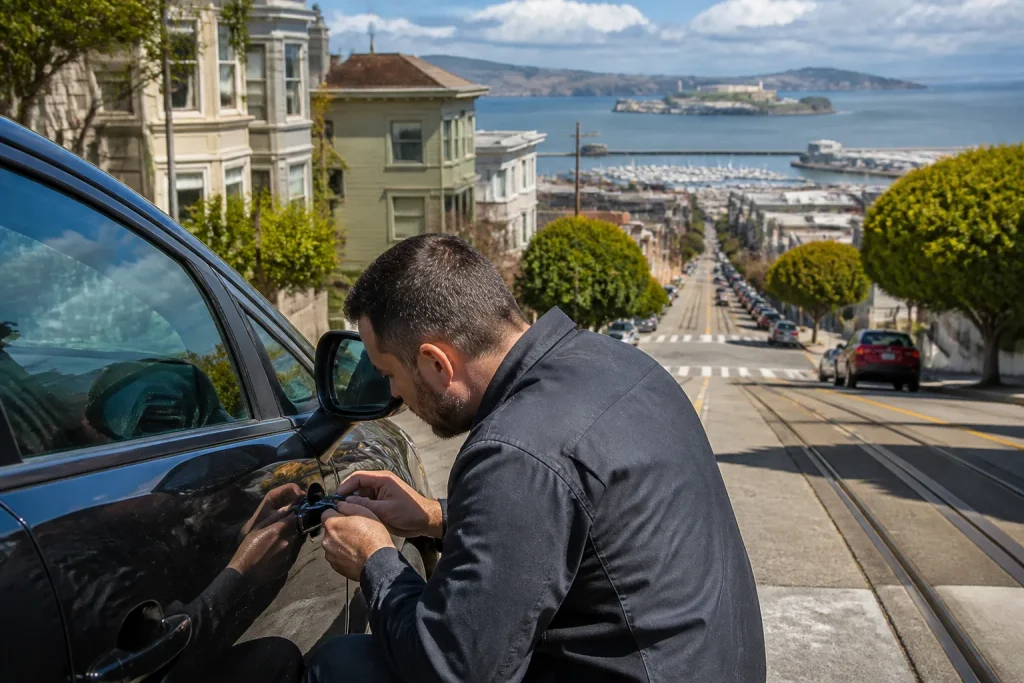
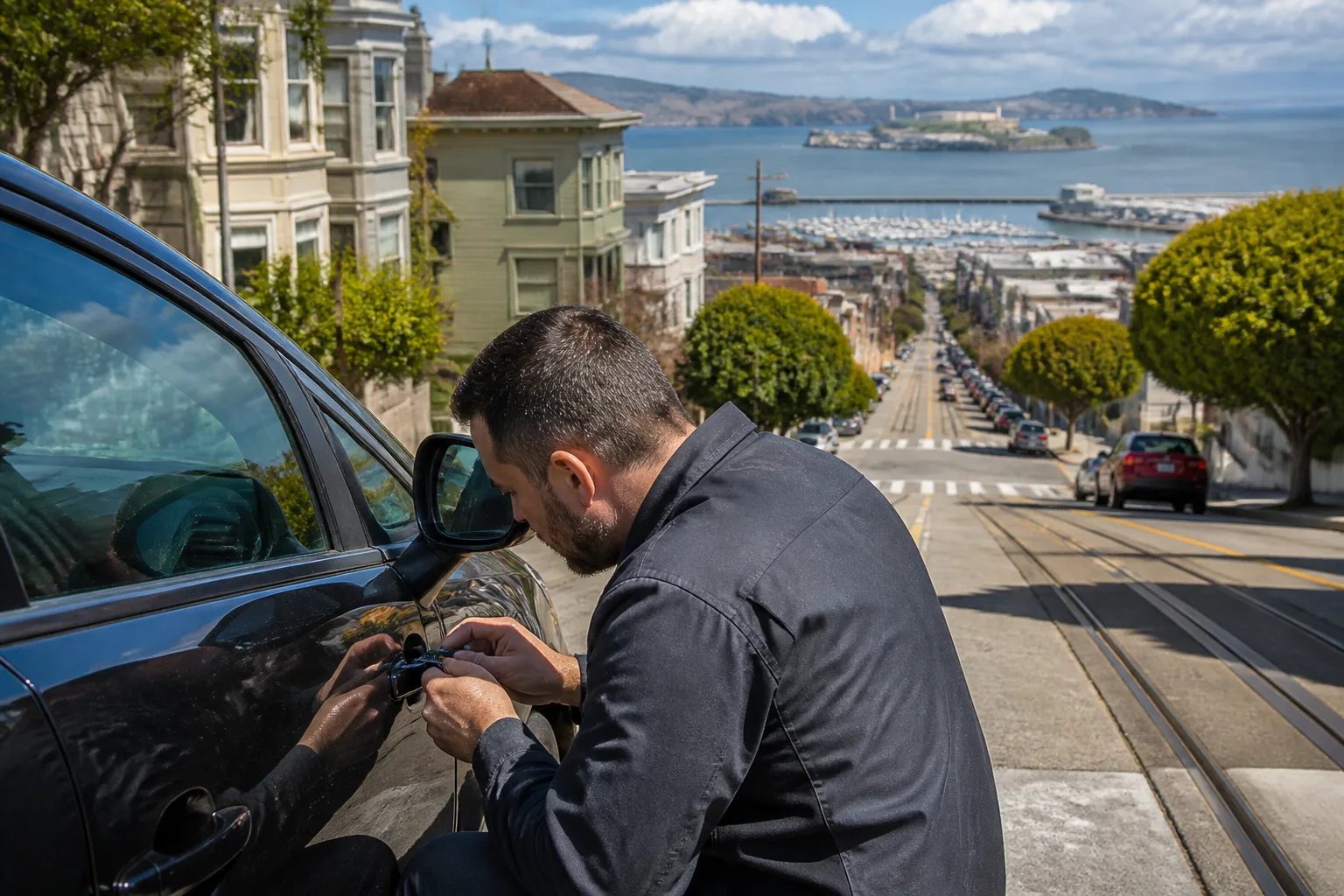
For San Francisco homeowners specifically: parking in a garage on a hillside means towing a car to a dealership can require street-level access, a flatbed, and coordination with the building manager. A mobile automotive locksmith eliminates all of that by coming to the vehicle. That’s not a small convenience in this city; it’s often the difference between a one-hour fix and a two-day ordeal.
Related services in San Francisco: if you’re dealing with car key replacement anywhere on the Peninsula or in the South Bay, our Car Key Replacement in Mountain View page covers pricing and process in that market. For urgent lockouts, see our Emergency Locksmith in Mountain View service. And if you’ve just moved into a new place in San Francisco and don’t know who might have a copy of your keys, our Rekey Locks guide is the fastest way to take back control.
What to Ask Any Locksmith Before You Commit
If you’re in San Francisco and comparing locksmiths for Yale residential work or car key replacement, ask these questions. The answers will tell you more than any review:
- “What brands do you work with on a daily basis?” A locksmith who says “all of them” without naming specifics is a red flag. You want to hear brand names: Yale, Schlage, Kwikset, Mul-T-Lock, Medeco, Baldwin, Sargent, Abloy. Fluency across that range means they’ve handled both consumer hardware and high-security commercial systems.
- “Do you cut and program car keys on-site, or do you send them out?” The right answer is on-site, with mobile equipment. If they send keys out, you’re paying for a middleman.
- “Can you rekey my Yale lock without replacing it?” Any competent locksmith can rekey a Yale cylinder. If they insist on replacement for a lock that isn’t damaged, they’re selling parts, not diagnosis.
- “What’s your pricing structure for car keys?” You want a price range based on your vehicle’s make and model, not a teaser number that changes on arrival. A real locksmith quotes from a database, not from a guess.
What You’ll Actually Pay in San Francisco
Let’s be direct about money. San Francisco car key replacement prices run higher than national averages because of the city’s cost structure, not because anyone is gouging you. Here’s what we see in the current market:
| Vehicle Type | Typical Key Type | Independent Locksmith Range | Dealership Range |
|---|---|---|---|
| Older Honda, Toyota, Ford (pre-2000) | Mechanical key | $75 – $150 | $100 – $200 |
| Mid-2000s to mid-2010s sedan | Transponder chip key | $120 – $250 | $250 – $400 |
| Modern push-to-start vehicle | Proximity fob | $250 – $450 | $400 – $650 |
| European luxury (BMW, Mercedes, Audi) | Laser-cut high-security key | $300 – $550 | $500 – $800+ |
These are honest San Francisco market ranges as we see them in 2025. The single most important thing to ask any locksmith before they dispatch: “Is the price you quoted on the phone the price on the invoice?” Get that in writing or at least in a recorded call. Too many people in this trade advertise a low number and then add “service fees” on arrival. We don’t do that. The number we quote before we roll a truck is the number you pay. No arrival surcharge, no hidden dispatch fee.
For Yale residential work in San Francisco, a standard rekey of a Yale deadbolt runs $40 – $85 per cylinder depending on whether it’s a standard pin tumbler or a high-security model. That’s the price for taking back control of a lock after a move, a break-in scare, or a lost key.
The Bottom Line
Yale car key replacement in San Francisco is a search that starts from a reasonable assumption and runs into a hardware reality: Yale builds locks for doors, not cars. If your actual car key needs to be replaced, you need an automotive locksmith with programming equipment for your vehicle’s make and model. If your Yale home lock is the thing failing, you need a locksmith who can work on Yale cylinders without replacing them unnecessarily. If you need both – and plenty of San Francisco homeowners do – you need a full-spectrum shop that handles residential and automotive in one call.
That’s the role Citadel Locksmith fills. We work with the brands serious about security, we diagnose before we cut, and we show up. If you’re in San Francisco and need help, call (833) 589-8078 for a free estimate. The price we quote on the phone is the price on the invoice, and we’ll tell you honestly whether a repair is possible or a replacement is the right call. No scare tactics, no upsell, no invented urgency.
Learn more about what we do across the full scope of lock and key work at the Citadel Locksmith home.
Frequently Asked Questions
No. Yale manufactures residential and light-commercial door hardware – deadbolts, knob locks, lever locks, padlocks, and smart locks – but has no presence in automotive key systems. Car keys are made by the vehicle’s manufacturer and its key suppliers, and replacement requires cutting and programming equipment specific to your car’s make and model.
No. That’s a residential hardware problem. A Yale key that won’t turn in a Yale deadbolt is either a worn key, a worn cylinder, or a misaligned strike plate. All three are standard locksmith repairs. In San Francisco, marine air and older door frames compound these issues, but they’re typically fixed in under an hour. Call (833) 589-8078 for an exact diagnosis and quote – estimates are free.
For most vehicles, expect $75 to $550 depending on the key type. Mechanical keys run $75 – $150, transponder chip keys $120 – $250, proximity fobs $250 – $450, and European laser-cut keys $300 – $550 at independent locksmiths. Dealership pricing runs 50% to 100% higher. Always confirm the phone quote is the final invoice price before dispatch.
Yes, but only if they’re a full-spectrum shop. Many San Francisco locksmiths specialize in either residential or automotive work exclusively. Citadel Locksmith handles both, which means a single call covers your home’s Yale hardware, your car key, and any emergency lockout. Call (833) 589-8078 to confirm what you need.
Written by the team at Citadel Locksmith, serving San Francisco since 2011.
Need Locksmith Help?
Call Citadel Locksmith — licensed & insured, here with fast after-hours help in San Francisco.
(833) 589-8078